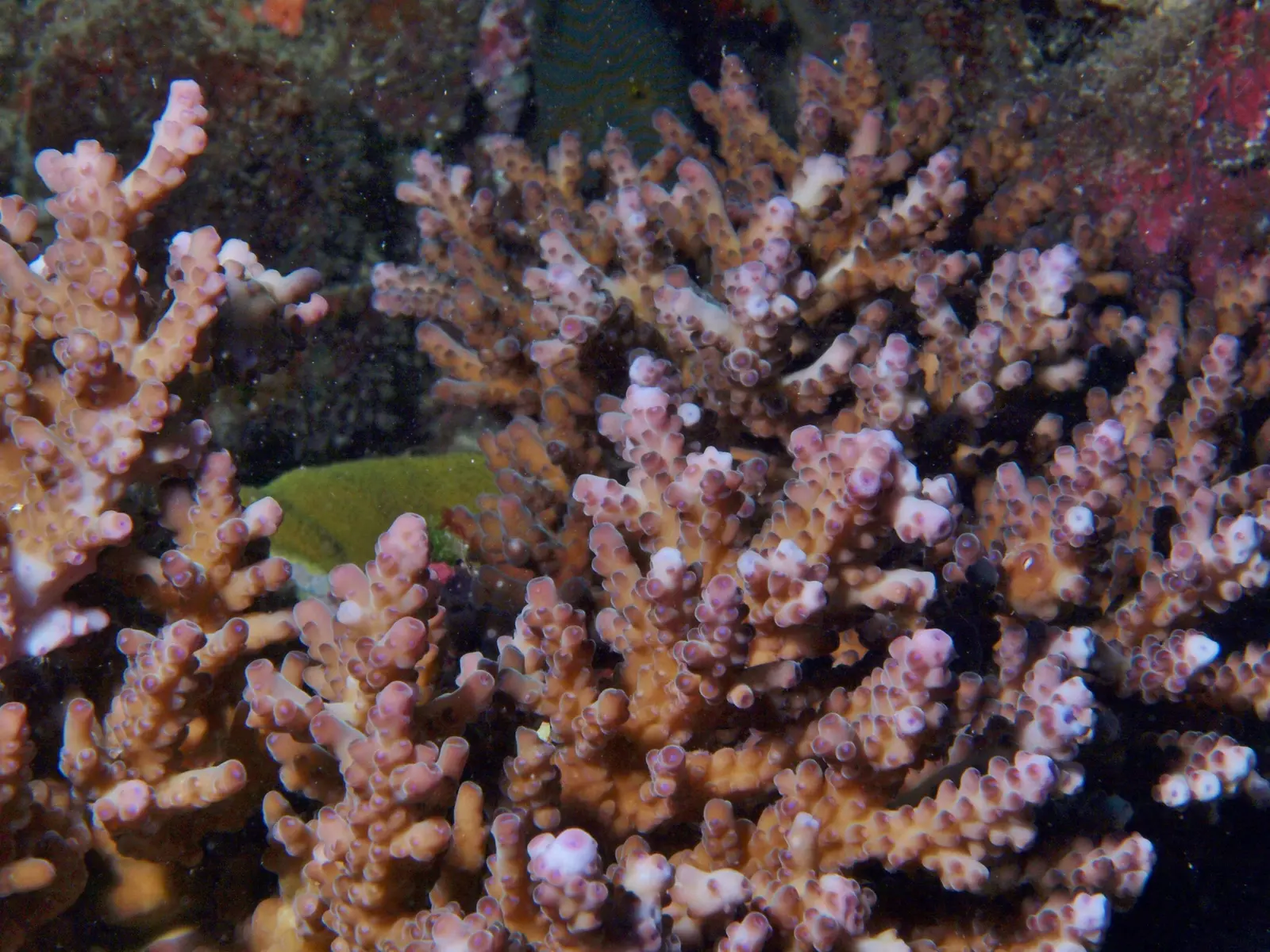
Acropora Solitaryensis Coral (Acropora solitaryensis) is a plate-forming or branching western Pacific Acropora associated with tropical and subtropical reef habitat.
See Acropora Solitaryensis Coral clearly
Select any thumbnail to open the unobstructed full-size image in a separate window.
Responsible care profile
Its plate-forming growth can shade a wide area; reserve horizontal clearance and keep water moving across both surfaces. Any displayed preferred aquarium volume is an MLL planning example, not a demonstrated species minimum; size the permanent placement for the actual colony, growth and maintenance access.
The structured record includes multiple references and at least one dedicated aquarium-care source.
6 referenced sources- Care level
- Advanced
- Minimum volume
- Not specified in current guidance
- Preferred volume
- 125.5 US gal (475 L)
- Adult size
- Not specified in current record
- Reef compatibility
- Reef-Safe with Caution
- Temperament
- Fast growing stinging stony coral
- Social plan
- single documented colony with growth space
- Minimum footprint
- 120 × 50 cm / 47.2 × 19.7 in mature SPS reef
Water
Existing profile husbandry guidance — not a species-specific experimental optimum · Profile husbandry ranges are planning guidance, not demonstrated physiological limits. No different calcium or magnesium target is inferred from a trade colour name.
- Temperature
- 75.2–80.6 °F (24–27 °C)
- Salinity / specific gravity
- 1.024–1.026 SG
- pH
- 8.1–8.4
- Calcium
- 400–450 ppm
- Alkalinity
- 7.5–9 dKH
- Magnesium
- 1250–1400 ppm
Habitat
Placement: middle to upper reef with broad turbulent flow · stable permanent mount; high measured reef lighting; wide branching growth envelope
Spacing: Allow for branch extension, shading and contact aggression. Allow full tissue expansion and future growth. Check night-time sweeper or filament reach, including downstream neighbours, and increase clearance if contact is possible. No universal safe distance applies.
stable permanent mount; high measured reef lighting; wide branching growth envelope.
Not applicable; keep every branch in oxygenated moving water.
Light: High, stable reef lighting after gradual acclimation.
Flow: Strong random turbulent flow without a constant tissue-stripping jet.
Feeding
photosymbiotic planktivore · Stable light and dissolved nutrients are foundational; occasional fine marine plankton may supplement growth. · Food options: fine marine plankton · Prioritize stable alkalinity, temperature and salinity over chasing rapid growth.
Compatibility
Allow for branch extension, shading and contact aggression.
Avoid or assess carefully: corallivorous fish, stinging neighbouring corals, unstable new aquariums.
What the evidence establishes
Coral editorial batch 3: targeted source/wording corrections; this date does not validate every numerical range or establish full lifetime care.
Acclimation and quarantine
Require lawful provenance, quarantine and inspect for flatworms, red bugs and tissue loss; acclimate light gradually.
Stocking safeguards
Aquarium setting: Home aquarium. Starvation risk: moderate.
After chemistry, flow and lighting remain stable for an extended period.
- No immature or chemically unstable aquarium
- No undocumented CITES origin
- No placement without pest quarantine
Special risks
- Rapid tissue necrosis
- Acropora-eating flatworms
- Red bugs
- Light shock
- Regulated trade
Habitat and Distribution
A plate-forming or branching western Pacific Acropora associated with tropical and subtropical reef habitat. Its documented range includes Western Pacific, Japan, Australia.
Feeding and Ecological Role
Relies strongly on photosynthetic symbionts while also capturing plankton and suspended material. Corals of the World treats this taxon as a species complex; source-labelled photographs do not independently resolve its component identities.
Conservation and Responsible Sourcing
Use current taxonomic, conservation, and CITES sources before acquisition or movement. Verify legal origin, collection method, and current trade requirements before acquisition.
Editorial and Source Review
Reviewed 2026-10-20 in coral batch 3. Editorial structure, source support and photographic identity are separate checks; this review does not certify every biological claim or specimen identification.
Image confidence: Source-assigned identity retained; independent species diagnosis not established.. Local contact sheet batch-03-contact.jpg examined for gross mismatch and image context; source filenames and credits are provenance evidence, not diagnostic proof.
Review findings
- The reference supports fused basal branches/plates and subtropical rocky foreshores, and explicitly flags a species complex; add this qualification.
- The 285-litre minimum has no matched supporting minimum-space evidence in the supplied citations. Remove it as a verified minimum; retain qualitative clearance guidance and the preferred-volume planning example with explicit scope.
Evidence still needed
- A source-matched minimum lifetime enclosure has not been established; assess the actual colony and growth envelope.
A living record
Taxonomy is checked against WoRMS and species context against Corals of the World; trade language points to the current CITES Appendices. Generic Acropora photographs remain genus-bound and are not assigned to species from appearance alone. Public content last reviewed October 20, 2026.
- World Register of Marine Species — Acropora solitaryensis ↗Taxonomic authority
- Corals of the World — Acropora solitaryensis ↗Scientific reference
- CITES Appendices ↗International treaty authority