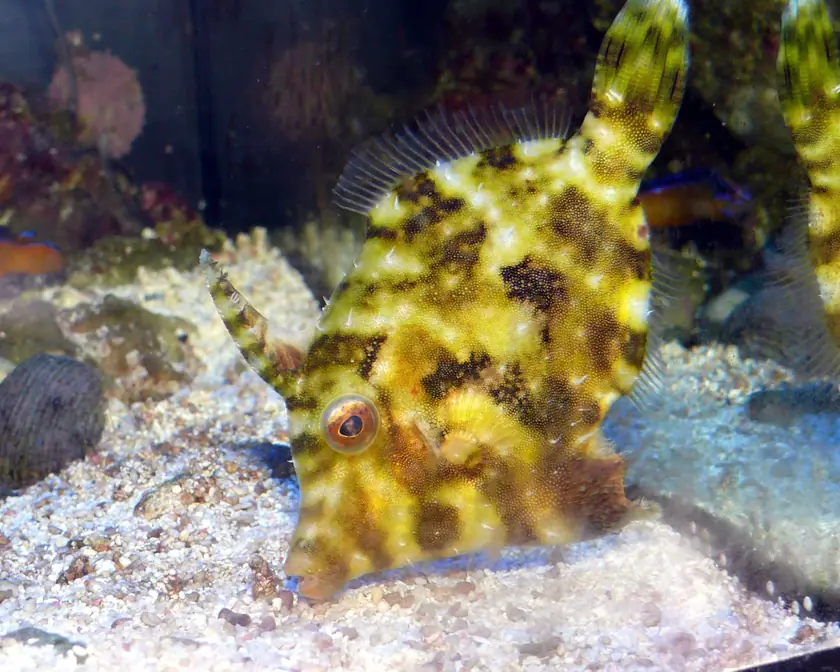
A small, camouflaged filefish also called the bristle-tail leatherjacket. Its aquarium reputation comes from eating pest Aiptasia anemones, although individual performance varies and it also eats other foods. An irregularly mottled green, brown or tan body blends into vegetation. Pale bands may cross the eye and body; small skin flaps and a barbed dorsal spine add to the broken outline. Males develop an elongated patch of bristles on the tail stalk. Recorded maximum length is approximately 11.5 cm.
See Aiptasia-eating Filefish clearly
Select any thumbnail to open the unobstructed full-size image in a separate window.
Responsible care profile
Choose an established feeding specimen, preferably a cultured fish with a known feeding history. ORA reports acceptance of common aquarium fish foods, so provide regular feeding even when Aiptasia is present. Sheltered structure and calm feeding opportunities are sensible planning choices based on its natural habitat and ORA’s description of peaceful behavior. Observe the individual after introduction: Aiptasia feeding may take days or weeks, and some fish never perform reliably. Monitor valuable corals closely; removal or a separate system may be necessary if nipping develops.
The structured record includes multiple references and at least one dedicated aquarium-care source.
5 referenced sources- Care level
- Advanced
- Minimum volume
- 30 US gal (113.6 L)
- Preferred volume
- Not specified in current guidance
- Adult size
- 5.5 in (14 cm) · standard length, excluding tail
- Reef compatibility
- Reef-Safe with Caution
- Temperament
- May nip both hard and soft corals; reef compatibility is conditional. Aiptasia removal is variable and should not replace a broader pest management plan. A supply of pest anemones alone is not an adequate feeding plan. A guarding female may defend her egg site vigorously.
- Social plan
- Review documented species interactions before grouping.
Water
Species-specific Bob Goemans husbandry recommendation; not an experimental tolerance boundary · Profile husbandry ranges are planning guidance, not demonstrated physiological limits. No different calcium or magnesium target is inferred from a trade colour name.
- Temperature
- 72–82 °F (22.2–27.8 °C)
- Salinity / specific gravity
- 1.020–1.026 SG
- pH
- 8.0–8.5
Habitat
Use the species-specific habitat and keeping guidance below.
Feeding
Wild prey includes small bottom-dwelling crustaceans, polychaete worms and molluscs. ORA has used this species to control Aiptasia in its coral greenhouse. Mottled coloration can change rapidly with surroundings and mood. It should not be described as an anemone specialist or guaranteed pest-control animal. · Three small meals daily · Food options: Mysis shrimp, Enriched brine shrimp, Chopped clam, Chopped squid, Chopped marine fish, Chopped marine shrimp, Krill, Frozen marine carnivore food · Choose an established feeding specimen, preferably a cultured fish with a known feeding history. ORA reports acceptance of common aquarium fish foods, so provide regular feeding even when Aiptasia is present. Sheltered structure and calm feeding opportunities are sensible planning choices based on its natural habitat and ORA’s description of peaceful behavior. Observe the individual after introduction: Aiptasia feeding may take days or weeks, and some fish never perform reliably. Monitor valuable corals closely; removal or a separate system may be necessary if nipping develops. Source: species-specific aquarium author guidance; meal count is a husbandry recommendation, not a validated nutritional limit.
Compatibility
May nip both hard and soft corals; reef compatibility is conditional. Aiptasia removal is variable and should not replace a broader pest-management plan. A supply of pest anemones alone is not an adequate feeding plan. A guarding female may defend her egg site vigorously.
What the evidence establishes
Species-specific natural history and bounded keeper or research evidence.
- Identification and habitat
- Species-specific feeding and suitability assessment
- Reported maximum body size with measurement type
- temperature_c
- specific_gravity
- ph
- minimum_volume
Only claims supported within the named source scope are presented. Unspecified numerical settings are not certified.
Acclimation and quarantine
MLL precaution: confirm identification, demonstrated food acceptance and the supplier’s actual water conditions before transfer; retain a species-specific quarantine plan.
Stocking safeguards
Aquarium setting: Home aquarium. Starvation risk: high.
- Confirm food acceptance and permanent adult housing before acquisition.
Special risks
- May nip both hard and soft corals; reef compatibility is conditional. Aiptasia removal is variable and should not replace a broader pest-management plan. A supply of pest anemones alone is not an adequate feeding plan. A guarding female may defend her egg site vigorously.
Husbandry Findings and Limits
These findings explain what the cited evidence supports. Facility precautions are identified separately from tested captive outcomes.
Documented aquarium husbandry — Documented keeping guidance; not a controlled trial
Feeding: Wild prey includes small bottom-dwelling crustaceans, polychaete worms and molluscs. ORA has used this species to control Aiptasia in its coral greenhouse. Mottled coloration can change rapidly with surroundings and mood. It should not be described as an anemone specialist or guaranteed pest-control animal.. Three small meals daily Food options: Mysis shrimp, Enriched brine shrimp, Chopped clam, Chopped squid, Chopped marine fish, Chopped marine shrimp, Krill, Frozen marine carnivore food. Use the species-specific habitat and keeping guidance below. May nip both hard and soft corals; reef compatibility is conditional. Aiptasia removal is variable and should not replace a broader pest-management plan. A supply of pest anemones alone is not an adequate feeding plan. A guarding female may defend her egg site vigorously. MLL precaution: confirm identification, demonstrated food acceptance and the supplier’s actual water conditions before transfer; retain a species-specific quarantine plan.
Scope and remaining limit: Species-matched author guidance is available; it is not a controlled lifetime trial. A recorded maximum wild length is not an enclosure minimum. Study settings and keeper recommendations are not demonstrated lifelong tolerance limits.
Sources: ORA — direct greenhouse keeping observations and Aiptasia-eating Filefish guidance · IFMN — Guddat and Kahlert first-hand Acreichthys tomentosus breeding report · Bob Goemans — species-specific feeding and keeping accountIdentification
An irregularly mottled green, brown or tan body blends into vegetation. Pale bands may cross the eye and body; small skin flaps and a barbed dorsal spine add to the broken outline. Males develop an elongated patch of bristles on the tail stalk. Recorded maximum length is approximately 11.5 cm.
Habitat and Distribution
Sheltered shallow reefs and seagrass habitats, recorded from the surface to about 15 m. Its range extends across the tropical eastern Indian and western Pacific oceans, from Sri Lanka to New Caledonia and north to Japan.
Feeding and Ecology
Wild prey includes small bottom-dwelling crustaceans, polychaete worms and molluscs. ORA has used this species to control Aiptasia in its coral greenhouse. Mottled coloration can change rapidly with surroundings and mood. It should not be described as an anemone specialist or guaranteed pest-control animal.
Reproduction and Evidence
Successful breeder observations describe eggs deposited in a small sandy depression and guarded by the female. Gerd Guddat and Achim Kahlert reported raising juveniles after moving eggs with their sand into a separate rearing vessel. Tiny larvae required live zooplankton; their report specifically describes rotifers with phytoplankton and frequent water changes. These observations establish captive breeding, but do not provide a universal home-aquarium rearing recipe.
Aquarium Suitability and Keeping Context
Choose an established feeding specimen, preferably a cultured fish with a known feeding history. ORA reports acceptance of common aquarium fish foods, so provide regular feeding even when Aiptasia is present. Sheltered structure and calm feeding opportunities are sensible planning choices based on its natural habitat and ORA’s description of peaceful behavior. Observe the individual after introduction: Aiptasia feeding may take days or weeks, and some fish never perform reliably. Monitor valuable corals closely; removal or a separate system may be necessary if nipping develops.
Compatibility and Risks
May nip both hard and soft corals; reef compatibility is conditional. Aiptasia removal is variable and should not replace a broader pest-management plan. A supply of pest anemones alone is not an adequate feeding plan. A guarding female may defend her egg site vigorously.
A living record
Museum or institutional natural history, primary research where available, and explicitly attributed keeper guidance. Photo attribution supplied by the user and cross-checked where source pages were retrievable. Public content last reviewed October 3, 2026.
- Museums Victoria / Fishes of Australia — Bristle-tail Leatherjacket identification, habitat and diet ↗Reference source
- ORA — direct greenhouse keeping observations and Aiptasia-eating Filefish guidance ↗Reference source
- IFMN — Guddat and Kahlert first-hand Acreichthys tomentosus breeding report ↗Reference source