The captive-bred Berghia used for Aiptasia control, with a specialised food requirement that continues after an infestation is removed. Previously described as Aeolidiella stephanieae and widely sold under the misapplied name Berghia verrucicornis. Those are different species. Confirm the breeder’s identification before selecting a biological-control animal.
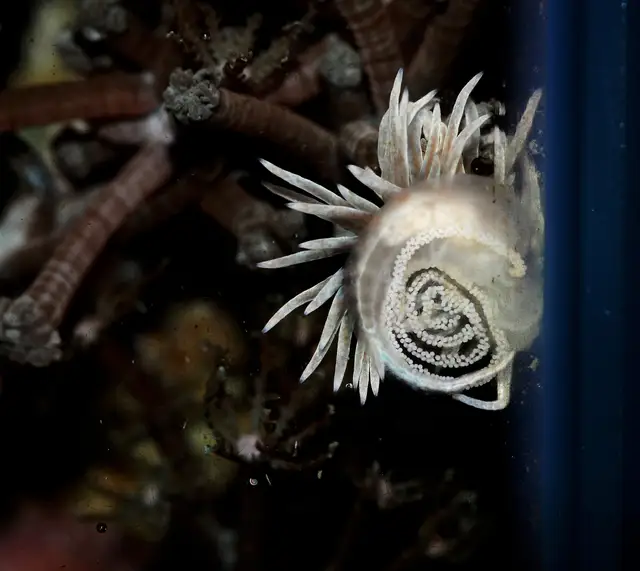
See Aiptasia-eating Berghia Sea Slug clearly
Select any thumbnail to open the unobstructed full-size image in a separate window.

Responsible care profile
Species-matched breeder and husbandry recommendations for practical aquarium care; no physiological tolerance, lifelong food replacement or guaranteed biological-control outcome is claimed. Required practical care fields are recorded; this is field coverage, not scientific certification or a compatibility guarantee.
The structured record includes multiple references and at least one dedicated aquarium-care source.
11 referenced sources- Care level
- Advanced
- Minimum volume
- Not specified in current guidance
- Preferred volume
- Not specified in current guidance
- Adult size
- Not specified in current record
- Reef compatibility
- Reef-Safe with Caution
- Temperament
- Population size must follow the available food supply; a numerical stocking rule is unverified.
- Social plan
- Population size must follow the available food supply; a numerical stocking rule is unverified.
Water
Berghia Farm breeder husbandry recommendation — https://berghiaschnecke.de/en/pages/berghia-schnecken-haltung-eingewohnung · Bob Goemans species aquarium recommendation — https://www.saltcorner.com/AquariumLibrary/browsespecies.php?CritterID=3814 · Breeder Berghia Farm recommends24–26°C and pH8.1–8.4. SG1.023–1.025 is the separately cited Goemans aquarium range; breeder density shorthand is not used as a calibrated SG conversion. Maintain an adequate Aiptasia food supply and arrange rehoming when it is depleted; these specialist nudibranchs cannot be sustained on substitute foods.
- Temperature
- 75.2–78.8 °F (24–26 °C)
- Salinity / specific gravity
- 1.023–1.025 SG
- pH
- 8.1–8.4
Habitat
Food-anemone surfaces with protected access; MLL precaution: secure shelter and make the verified food source accessible.
Light: No validated species-specific lighting target established.
Flow: MLL precaution: design flow for food access and safe refuge; a numerical target remains unverified.
Feeding
Specialist Aiptasia predator · Observe actual food access and intake; a validated species-specific ration or frequency is not established here. · Food options: Live, correctly identified Aiptasia food anemones · Provide a continuing supply of correctly identified food anemones. Museum correspondence documents starvation after Aiptasia depletion. MLL precaution: plan food continuity or a responsible transfer before the remaining prey disappears.
Compatibility
Population size must follow the available food supply; a numerical stocking rule is unverified.
Avoid or assess carefully: Starvation after Aiptasia depletion, Mistaken Berghia identity, Predation or injury during transfer.
What the evidence establishes
Species-matched breeder and husbandry recommendations for practical aquarium care; no physiological tolerance, lifelong food replacement or guaranteed biological-control outcome is claimed.
- Current species identity
- Documented captive breeding
- Aiptasia feeding
- Food-depletion starvation risk
- Stage-specific prey access and juvenile competition
- 2026-10-03 bounded evidence component: Corroborated numerical water and enclosure limits
- Supported within source scope: A complete population- and life-stage-specific rearing protocol
- water.temperature_c
- water.specific_gravity
- water.ph
- evidence_scope
- water_provenance.temperature_c
- water_provenance.ph
- water_provenance.specific_gravity
- water_guidance
2026-10-14 follow-up review: Species-matched breeder and husbandry recommendations for practical aquarium care; no physiological tolerance, lifelong food replacement or guaranteed biological-control outcome is claimed.
Acclimation and quarantine
MLL precaution: confirm identity and source temperature and salinity; obtain a species-appropriate transfer plan before acquisition.
Stocking safeguards
Aquarium setting: Home aquarium. Starvation risk: high.
Only after identity, reliable food supply and housing have been established.
- No acquisition without a sustainable species-appropriate food plan
- No unsupported numeric limits presented as guaranteed safe thresholds
Special risks
- Starvation after Aiptasia depletion
- Mistaken Berghia identity
- Predation or injury during transfer
Husbandry Findings and Limits
These findings explain what the cited evidence supports. Facility precautions are identified separately from tested captive outcomes.
2026-10-14 care follow-up — Documented keeping guidance; not a controlled trial
Breeder specifies24–26°C and pH8.1–8.4 for its Berghia stephanieae stock. Named species aquarium account gives SG1.023–1.025 and warns that survival without Aiptasia is extremely limited.
Scope and remaining limit: Species-matched breeder and husbandry recommendations for practical aquarium care; no physiological tolerance, lifelong food replacement or guaranteed biological-control outcome is claimed.
Sources: Berghia Farm — breeder husbandry and acclimation · Bob Goemans — Berghia stephanieae aquarium accountPractical Keeping Review
The practical keeping questions have been reviewed against the cited sources. Read the source scope and remaining limits before applying the guidance.
Documented research limits and optional breeding questions are separate from everyday keeping. This review does not certify universal safe thresholds or complete lifetime validation.
Scientific Care Evidence
These findings distinguish a demonstrated method from an unanswered question. A supported finding applies within the named study or institutional scope; experimental settings are not universal safe limits.
Breeding and young animals — Supported within source scope
Species-confirmed laboratory methods describe breeding pairs, egg transfer and incubation, hatching, daily juvenile prey and selection of new breeders; successful seventh-generation culture demonstrates a complete rearing cycle for this stock.
Scope and remaining limit: Supported for this documented supplier-origin laboratory stock and culture system; not every geographic population. The newer 2026 optimization is abstract-only.
Sources: Silva et al. 2025: captive culture methods and thermal experiments · Silva et al. (2026): optimized Berghia breeding protocolWater and space — Partial evidence
Independent culture methods report 23°C/33 PSU/pH 8.0 for pairs; another maintains successive generations at salinity 35. A seven-day 32°C exposure reduced egg production compared with 27°C.
Scope and remaining limit: Physiological tolerances and general display density remain unvalidated.
Sources: Berghia stephanieae culture and symbiosis study (2022) · Berghia heatwave and feeding experiment (2025)Feeding and stocking — Partial evidence
A defined Exaiptasia diet, egg separation and daily tiny-anemone feeding produced fourth-generation captive animals. Independent culture methods document pair housing and stage-specific foods; the 2026 abstract reports higher juvenile output.
Scope and remaining limit: Universal ration and display stocking density remain unvalidated.
Sources: Berghia heatwave and feeding experiment (2025) · Berghia stephanieae culture and symbiosis study (2022) · Silva et al. (2026): optimized Berghia breeding protocolSource methods and retrieval scope
- Berghia stephanieae culture and symbiosis study (2022)
Fresh full primary culture methods; six breeding pairs and offspring. · Full text reviewed
- Silva et al. 2025: captive culture methods and thermal experiments
Fresh full-text methods, supplier-origin laboratory stock through seventh generation. · Full text reviewed
- Berghia heatwave and feeding experiment (2025)
Fresh full primary methods; four cultured generations followed by a seven-day heatwave trial. · Full text reviewed
- Silva et al. (2026): optimized Berghia breeding protocol
Fresh primary search abstract; publisher full text could not be retrieved. · Abstract reviewed
Scientific sources reviewed 2026-10-03.
Care Questions and Limits
These practical answers explain the supported guidance and the limits that matter when caring for this organism. Read them with the suitability assessment and the sources. A completed practical review does not establish a complete lifetime or breeding protocol.
Water and space
Species-matched cultures maintained pairs at 23°C, salinity 33 PSU and pH 8.0; another successive-generation system used salinity 35. Follow one documented culture programme and its water renewal methods rather than mixing experimental endpoints. A seven-day 32°C stress exposure is not a recommended permanent target.
Evidence limit: Physiological tolerances and general display density remain unvalidated.
Sources: Berghia stephanieae culture and symbiosis study (2022) · Berghia heatwave and feeding experiment (2025)Feeding and stocking
Maintain a continuous Aiptasia food supply. Recorded culture feeds small anemones to hatchlings daily as needed and follows growth before transferring animals. Plan food availability before stocking; when Aiptasia is exhausted, arrange food or responsible transfer rather than leaving predators to starve.
Evidence limit: Universal ration and display stocking density remain unvalidated.
Sources: Berghia heatwave and feeding experiment (2025) · Berghia stephanieae culture and symbiosis study (2022) · Silva et al. 2026: optimized Berghia breeding protocolBreeding and young animals
Species-confirmed laboratory methods describe breeding pairs, egg transfer and incubation, hatching, daily juvenile prey and selection of new breeders; successful seventh-generation culture demonstrates a complete rearing cycle for this stock.
Evidence limit: Supported for this documented supplier-origin laboratory stock and culture system; not every geographic population. The newer 2026 optimization is abstract-only.
Sources: 2025 life-stage thermal stress experiment · Silva et al. 2026: optimized Berghia breeding protocolReferences and scope
Species-specific identity and qualitative natural history; aquarium recommendations, aquaculture methods and MLL precautions are distinguished.
- WoRMS — accepted species, reviewed 1 October 2026
- Australian Museum — Sea Slug Forum species account; historical names checked against current taxonomy
- Australian Museum — food depletion in aquarium Berghia; identity corrected by the stephanieae account
- Goodheart et al. (2015) — supplied scientific photograph and nudibranch phylogeny
- Monteiro and colleagues: juvenile and adult Berghia feeding in culture (2020)
- 2025 life-stage thermal stress experiment
- Silva et al. 2026: optimized Berghia breeding protocol
- Berghia stephanieae culture and symbiosis study (2022)
- Berghia heatwave and feeding experiment (2025)
Practical guidance reviewed 2026-10-03. Remaining research uncertainties are retained in the care evidence section.
Identification
Previously described as Aeolidiella stephanieae and widely sold under the misapplied name Berghia verrucicornis. Those are different species. Confirm the breeder’s identification before selecting a biological-control animal.
Habitat and Distribution
The museum account documents Florida Keys origin. A photograph of captive egg laying establishes aquarium reproduction, not a broader wild distribution.
Feeding and Ecology
Museum observations and laboratory work identify Aiptasia anemones as food. The body can retain pigments and symbionts from its recent meals; a pale individual is not automatically a different species.
Reproduction and Evidence
Laboratory culture has been documented, although older papers used the incorrect name B. verrucicornis. The supplied photograph shows egg laying in an aquarium. Egg production does not guarantee juvenile survival.
Aquarium Planning
Provide a continuing supply of correctly identified food anemones. Museum correspondence documents starvation after Aiptasia depletion. MLL precaution: plan food continuity or a responsible transfer before the remaining prey disappears.
Responsible Observation and Sourcing
MLL precaution: favour documented, responsibly sourced material and observation over speculative collection. Check lawful origin and current conservation information. A photograph alone does not establish a Canadian occurrence.
Evidence update and care limits
Culture experiments found that small juveniles had difficulty with large intact Exaiptasia prey; divided prey improved access, while competition with adults increased juvenile mortality. Adult feeding treatments affected fecundity. This supports a stage-specific prey plan, not a fixed display stocking rate. MLL monitoring plan: Keep juvenile feeding access separate from adult competition; document continuing prey availability before the display's food anemones are exhausted.
A living record
Accepted taxonomy and species-specific evidence reviewed. Source-labelled images, historical names, aquarium recommendations and remaining gaps are distinguished. Public content last reviewed October 2, 2026.
- WoRMS — accepted species, reviewed 1 October 2026 ↗Reference source
- Australian Museum — Sea Slug Forum species account; historical names checked against current taxonomy ↗Reference source
- Australian Museum — food depletion in aquarium Berghia; identity corrected by the stephanieae account ↗Reference source
- Goodheart et al. (2015) — supplied scientific photograph and nudibranch phylogeny ↗Reference source
- Monteiro and colleagues: juvenile and adult Berghia feeding in culture (2020) ↗Reference source
- 2025 life-stage thermal stress experiment ↗Reference source
- Silva et al. 2026: optimized Berghia breeding protocol ↗Reference source
- Berghia stephanieae culture and symbiosis study (2022) ↗Reference source
- Berghia heatwave and feeding experiment (2025) ↗Reference source