Chocolate Chip Sea Cucumber (Isostichopus badionotus) is a large western Atlantic sea cucumber of seagrass, sand, rubble, and reef-associated habitats.
See Chocolate Chip Sea Cucumber clearly
Select any thumbnail to open the unobstructed full-size image in a separate window.
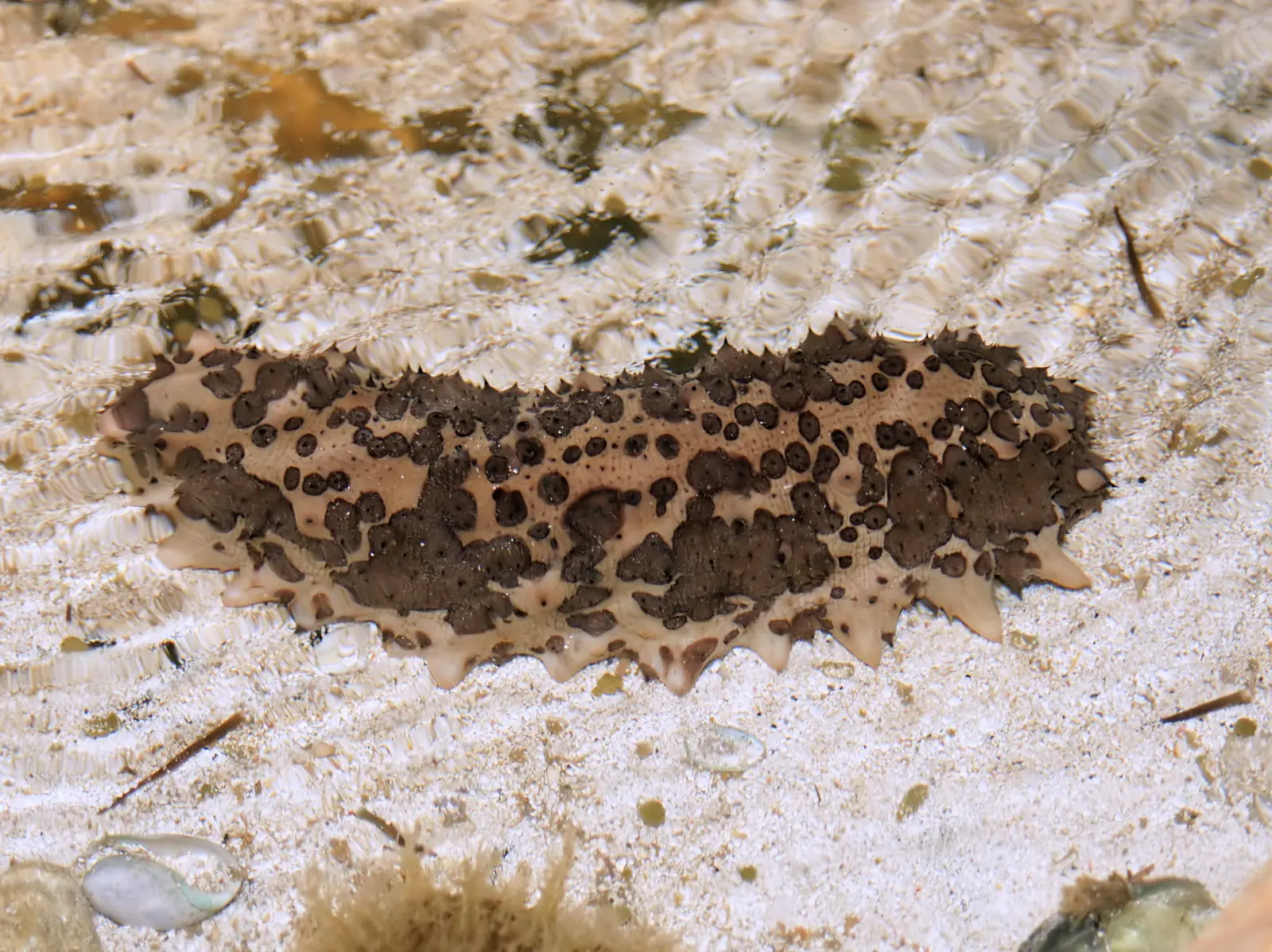
Specialist care plan required
Aquarium suitability has not yet been established for this record. Available observations do not constitute an acquisition recommendation.
Species-specific SaltCorner account flags not reef/fish-only suitable and identification-only/not collected for home trade. Available research maintenance or aquaculture findings do not establish a complete home display plan; retain known settings and unresolved fields, reassess against an actual source-population care programme.
Temperature: actual adultbroodstockRAS operatingrange2021primarymethods,notanoptimum.pH≈8: separate expert-derived Jamaica2021broodstock management recommendation,pHscale unstated;notanexperimental measuredrange. Natural salinity unspecified;noSG/PSU invented.
Outstanding care evidence
- specific_gravity: Species-matched adult numeric maintenance not established for this field in retrieved evidence.
- Species-specific SaltCorner account flags not reef/fish-only suitable and identification-only/not collected for home trade. Available research maintenance or aquaculture findings do not establish a complete home display plan; retain known settings and unresolved fields, reassess against an actual source-population care programme.
Acquisition assessment
Aquarium setting: Suitability review required. Starvation risk: high.
Species-specific SaltCorner account flags not reef/fish-only suitable and identification-only/not collected for home trade. Available research maintenance or aquaculture findings do not establish a complete home display plan; retain known settings and unresolved fields, reassess against an actual source-population care programme.
Only after substrate maturity and intake guards are verified.
- No new or sterile sand bed
- No competing deposit feeders
- No unguarded pumps
- No home-aquarium acquisition recommendation until a source-matched adult food, water and housing plan is established.
Assessment sources and scope
- WoRMS — Isostichopus badionotus
- SeaLifeBase — Isostichopus badionotus
- TFH — Sea-cucumber size, feeding and starvation safeguards
- Research study — wild and farmed Isostichopus badionotus
- 2021 Isostichopus badionotus wild and farmed body-wall transcriptomes
- Acuacultura| Pepino de mar del Caribe | Instituto Mexicano de Investigación en Pesca y Acuacultura Sustentable | Gobierno | gob.mx
- Zacarías-Soto et al. (2017): juvenile sea-cucumber diet experiment
- Gullian Klanian and Terrats Preciat 2017: control acclimation
- Bob Goemans: species aquarium suitability
- Jamaica Fisheries/AquaBioTech2021: broodstock managementp35
Reported culture conditions
These are source-specific observations, not a home-aquarium prescription.
- Temperature
- 75.2–78.8 °F (24–26 °C)
- pH
- 8
Temperature: actual adultbroodstockRAS operatingrange2021primarymethods,notanoptimum.pH≈8: separate expert-derived Jamaica2021broodstock management recommendation,pHscale unstated;notanexperimental measuredrange. Natural salinity unspecified;noSG/PSU invented. · Temperature: actual adultbroodstockRAS operatingrange2021primarymethods,notanoptimum.pH≈8: separate expert-derived Jamaica2021broodstock management recommendation,pHscale unstated;notanexperimental measuredrange. Natural salinity unspecified;noSG/PSU invented.
Husbandry Findings and Limits
These findings explain what the cited evidence supports. Facility precautions are identified separately from tested captive outcomes.
2026-10-14 care follow-up — Documented keeping guidance; not a controlled trial
Use the documented juvenile culture conditions only for the corresponding stock and stage. Numerical temperature, salinity, pH and density boundaries were not established as general adult tolerances. A sediment display should be planned from the actual culture programme rather than wild locality. Evidence limit: Corroborated adult numerical operating limits remain unverified. Adult collection stock held six days in 830-L sediment tanks at 26°C; controls at pH8.17 and35PSU. Daily collection-site sediment food. No experimental stress endpoints accepted. SaltCorner identifies this species as not collected for home aquarium trade; no adult parameter recommendation supplied.
Scope and remaining limit: Research observations remain contextual evidence only, not numeric aquarium recommendations. Adult source-matched recommendations remain unresolved.
Sources: Zacarías-Soto et al. (2017): juvenile sea-cucumber diet experiment · Gullian Klanian and Terrats Preciat 2017: control acclimation · Bob Goemans: species aquarium suitabilitySpecialist evidence review — October 2026 — Captive observation within source scope
Use the documented juvenile culture conditions only for the corresponding stock and stage. Numerical temperature, salinity, pH and density boundaries were not established as general adult tolerances. A sediment display should be planned from the actual culture programme rather than wild locality. Evidence limit: Corroborated adult numerical operating limits remain unverified. Adult collection stock held six days in 830-L sediment tanks at 26°C; controls at pH8.17 and35PSU. Daily collection-site sediment food. No experimental stress endpoints accepted. SaltCorner identifies this species as not collected for home aquarium trade; no adult parameter recommendation supplied. Expert-derived proposed I.badionotus adultbroodstock management:≈25°C,pH≈8,natural salinity;recirculating aerated trough30cmdeep withsand;groundalgae/fishfeed/spirulinain sand;foodbearing sand replaced everythird day,daily fecessiphon. Protocol explicitly says commercial speciesprotocols stillneed establishment;notan outcome trial. Section4.2: adultbroodstock maintained24–26°C inRAS withmechanical/biological filters,skimmer,UV,chiller,13:11photoperiod,dailyalgaemeal/sandfeed;spawnedspontaneouslyJuly–November. Exactadultduration,waterpHandsalinitynotreported.
Scope and remaining limit: Temperature: actual adultbroodstockRAS operatingrange2021primarymethods,notanoptimum.pH≈8: separate expert-derived Jamaica2021broodstock management recommendation,pHscale unstated;notanexperimental measuredrange. Natural salinity unspecified;noSG/PSU invented.
Sources: Zacarías-Soto et al. (2017): juvenile sea-cucumber diet experiment · Gullian Klanian and Terrats Preciat 2017: control acclimation · Bob Goemans: species aquarium suitability · Jamaica Fisheries/AquaBioTech2021: broodstock managementp35 · 2021 Isostichopus badionotus wild and farmed body-wall transcriptomesScientific Care Evidence
These findings distinguish a demonstrated method from an unanswered question. A supported finding applies within the named study or institutional scope; experimental settings are not universal safe limits.
Feeding and housing — Partial evidence
A 90-day juvenile Isostichopus badionotus trial tested four algae-based diets with or without a PUFA-rich additive. Spirulina-containing diets improved growth; survival and body composition did not differ by diet.
Scope and remaining limit: Complete adult ration and permanent stocking capacity remain unvalidated.
Sources: Zacarías-Soto et al. (2017): juvenile sea-cucumber diet experimentWater, space and stocking — Partial evidence
During the juvenile trial, monitored water was 25.0 ± 0.4 °C, pH 8, salinity 35 ± 1 g/L and oxygen approximately 5–7 mg/L.
Scope and remaining limit: Corroborated adult numerical operating limits remain unverified.
Sources: Zacarías-Soto et al. (2017): juvenile sea-cucumber diet experimentSource methods and retrieval scope
- Zacarías-Soto et al. (2017): juvenile sea-cucumber diet experiment
Fresh author-uploaded complete primary text; 90-day juvenile trial · Full text reviewed
Scientific sources reviewed 2026-10-03.
Care Questions and Limits
These practical answers explain the supported guidance and the limits that matter when caring for this organism. Read them with the suitability assessment and the sources. A completed practical review does not establish a complete lifetime or breeding protocol.
Feeding and housing
Controlled juvenile culture demonstrates feeding algae-based substrates; a 90-day trial tested diets with and without a PUFA-rich additive. Keep this as a juvenile culture pathway with documented substrate and growth monitoring, not a prescription to feed larvae or adults identically. An adult display needs accessible feeding sediment and sustained condition checks.
Evidence limit: Complete adult ration and permanent stocking capacity remain unvalidated.
Sources: Zacarías-Soto et al. (2017): juvenile sea-cucumber diet experimentWater, space and stocking
Use the documented juvenile culture conditions only for the corresponding stock and stage. Numerical temperature, salinity, pH and density boundaries were not established as general adult tolerances. A sediment display should be planned from the actual culture programme rather than wild locality.
Evidence limit: Corroborated adult numerical operating limits remain unverified.
Sources: Zacarías-Soto et al. (2017): juvenile sea-cucumber diet experimentReferences and scope
Species-specific culture methods; developmental-stage limitations
- WoRMS — Isostichopus badionotus
- SeaLifeBase — Isostichopus badionotus
- TFH — Sea-cucumber size, feeding and starvation safeguards
- Research study — wild and farmed Isostichopus badionotus
- 2021 Isostichopus badionotus wild and farmed body-wall transcriptomes
- Acuacultura| Pepino de mar del Caribe | Instituto Mexicano de Investigación en Pesca y Acuacultura Sustentable | Gobierno | gob.mx
- Zacarías-Soto et al. (2017): juvenile sea-cucumber diet experiment
Practical guidance reviewed 2026-10-03. Remaining research uncertainties are retained in the care evidence section.
Habitat and Distribution
A large western Atlantic sea cucumber of seagrass, sand, rubble, and reef-associated habitats. Its documented range includes Western Atlantic, Caribbean, Gulf of Mexico.
Feeding and Ecological Role
It is a deposit feeder that processes sediment and detrital organic material.
Conservation and Responsible Sourcing
Verify accepted identity, harvest controls, and lawful origin. Verify legal origin, collection method, and current trade requirements before acquisition.
Adult and larval culture are different tasks
A comparison of wild and farmed Isostichopus badionotus describes a breeding programme using collected adults and captive offspring. Larval culture used microalgal feeds, illustrating why evidence must specify the developmental stage.
What this means for aquarium care
MLL planning guidance: separate adult feeding plans from larval microalgal culture. Document actual food consumption and condition; culture methods alone do not validate the earlier generic aquarium volume or water ranges.
Evidence update and care limits
The methods document cultured Mexican stock and spontaneous broodstock spawning during the normal reproductive season. The main experiment compares body-wall transcriptomes, so it should not be represented as a trial validating the full captive diet or permanent aquarium stocking capacity. MLL monitoring plan: Retain stock origin and distinguish the documented culture methods from molecular results; require sustained substrate-food and adult-condition records.
A living record
Foundation profile reviewed against the World Register of Marine Species. Media are bound only where the source record explicitly establishes the species. Historical filenames and combinations remain in provenance, while the profile and publication binding use the accepted taxon. Public content last reviewed October 2, 2026.
- World Register of Marine Species — Isostichopus badionotus ↗Taxonomic authority
- Research study — wild and farmed Isostichopus badionotus ↗Reference source
- 2021 Isostichopus badionotus wild and farmed body-wall transcriptomes ↗Reference source
- Acuacultura| Pepino de mar del Caribe | Instituto Mexicano de Investigación en Pesca y Acuacultura Sustentable | Gobierno | gob.mx ↗Reference source
- Zacarías-Soto et al. (2017): juvenile sea-cucumber diet experiment ↗Reference source