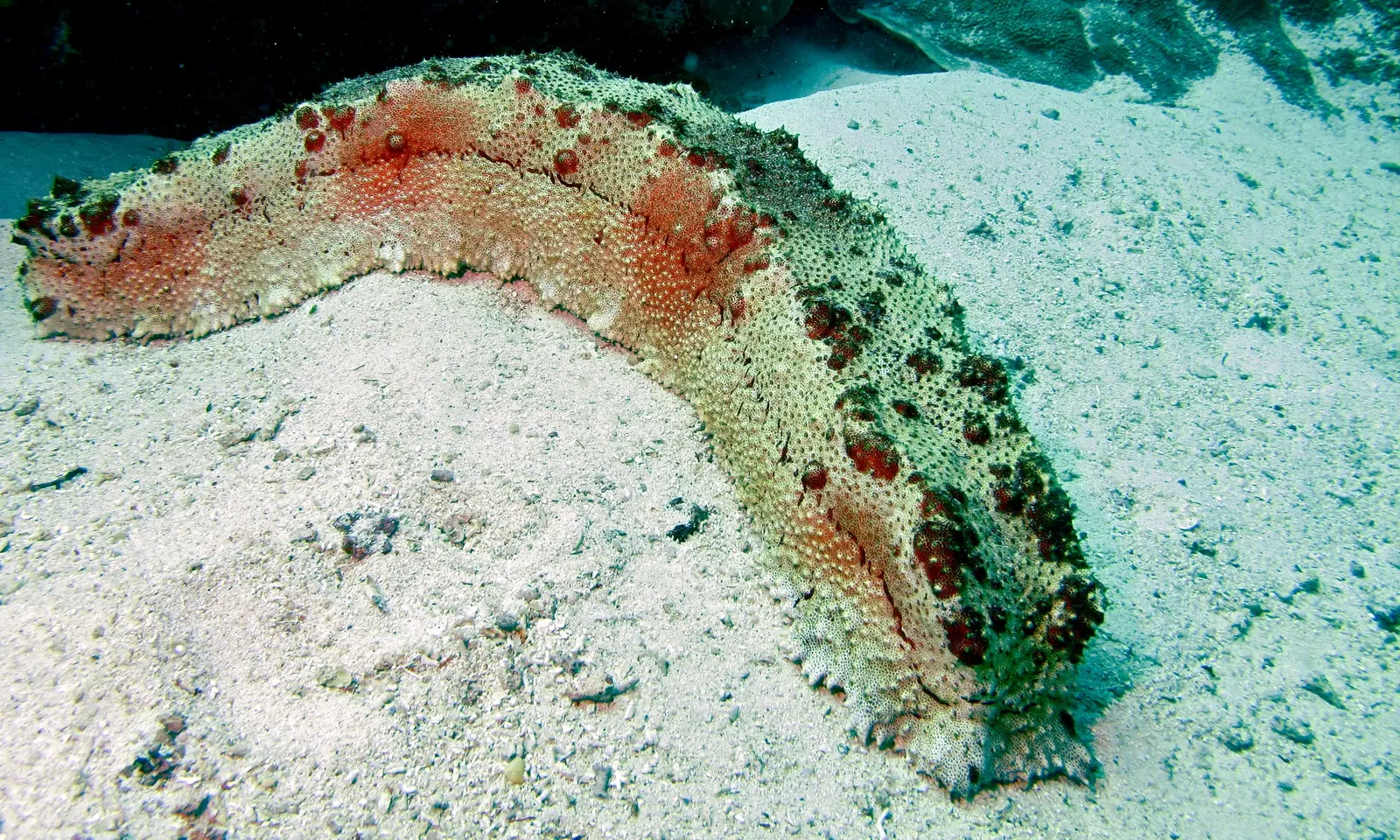
Amberfish Sea Cucumber (Thelenota anax) is a large tropical sea cucumber of reef slopes, lagoons, and sandy or rubble-strewn bottoms.
See Amberfish Sea Cucumber clearly
Select any thumbnail to open the unobstructed full-size image in a separate window.

Aquarium suitability awaiting assessment
Aquarium suitability has not yet been established for this record. Available observations do not constitute an acquisition recommendation.
The existing assessment does not establish aquarium suitability. Eligibility is reviewed separately before care completion is counted.
MLL planning guidance: verify identity and plan around its substantial body and substrate use. Habitat descriptions do not verify a tank footprint, stocking density, or renewable aquarium food supply. Numerical operating limits are unverified and have been withdrawn pending species-specific evidence.
Habitat and Distribution
A large tropical sea cucumber of reef slopes, lagoons, and sandy or rubble-strewn bottoms. Its documented range includes Indo-Pacific, Indian Ocean, Western Pacific.
Feeding and Ecological Role
It is a deposit feeder that processes surface sediments and associated organic material.
Conservation and Responsible Sourcing
Verify lawful and sustainable origin and do not infer harvest suitability from abundance in a photograph. Verify legal origin, collection method, and current trade requirements before acquisition.
Reef slopes and sandy lagoons
Thelenota anax is a large, roughly quadrangular sea cucumber associated with sandy reef slopes and outer lagoons. The FAO identification guide distinguishes its morphology and habitat from other traded sea cucumbers.
What this means for aquarium care
MLL planning guidance: verify identity and plan around its substantial body and substrate use. Habitat descriptions do not verify a tank footprint, stocking density, or renewable aquarium food supply.
Research review and remaining care gaps
Field observations link sediment processing to food availability and time of day. They do not establish a captive ration, sand area or enclosure minimum. Remaining evidence gaps: Complete species-specific long-term captive nutritional and housing protocol; Numerical temperature, salinity, pH, enclosure and stocking limits. Review completion does not establish fully verified husbandry.
A living record
Foundation profile reviewed against the World Register of Marine Species. Media are bound only where the source record explicitly establishes the species. Historical filenames and combinations remain in provenance, while the profile and publication binding use the accepted taxon. Public content last reviewed October 2, 2026.
- World Register of Marine Species — Thelenota anax ↗Taxonomic authority
- FAO — Commercially important sea cucumbers of the world ↗Reference source
- Field sediment-turnover study ↗Reference source
- Short‐term movement dynamics of the world’s largest sea cucumbers (genus Thelenota) - Gray - 2022 - Marine Ecology - Wiley Online Library ↗Reference source