The common thresher shark combines a streamlined body with an upper tail lobe that can account for roughly half its total length. That striking appendage is also a hunting tool. Its Canadian story connects seasonal Atlantic visits and rare Pacific records with the wider conservation of migratory predators.
See Common Thresher Shark clearly
Select any thumbnail to open the unobstructed full-size image in a separate window.
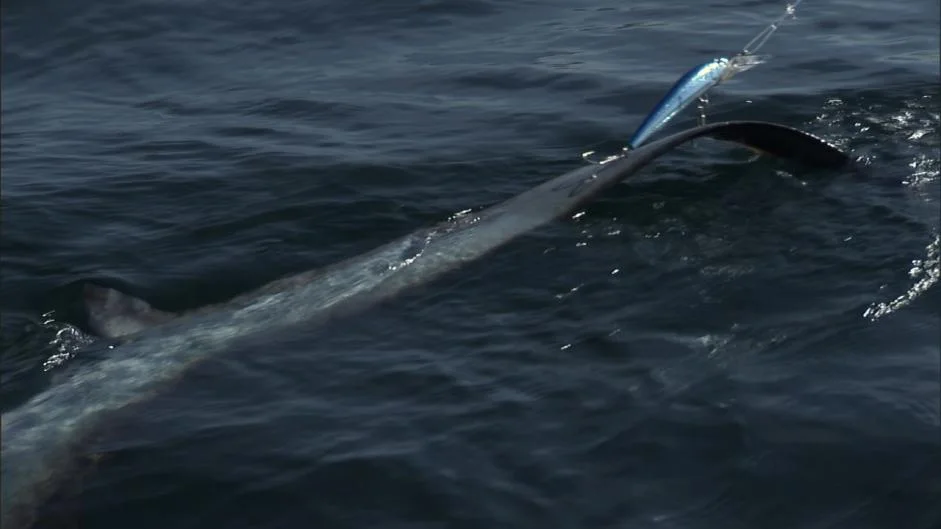
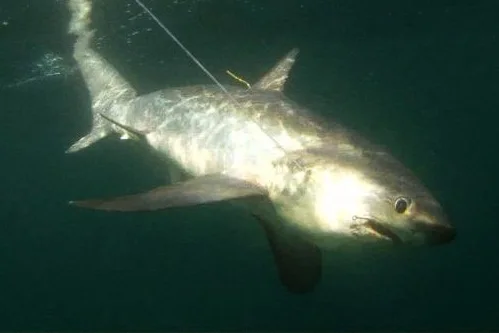
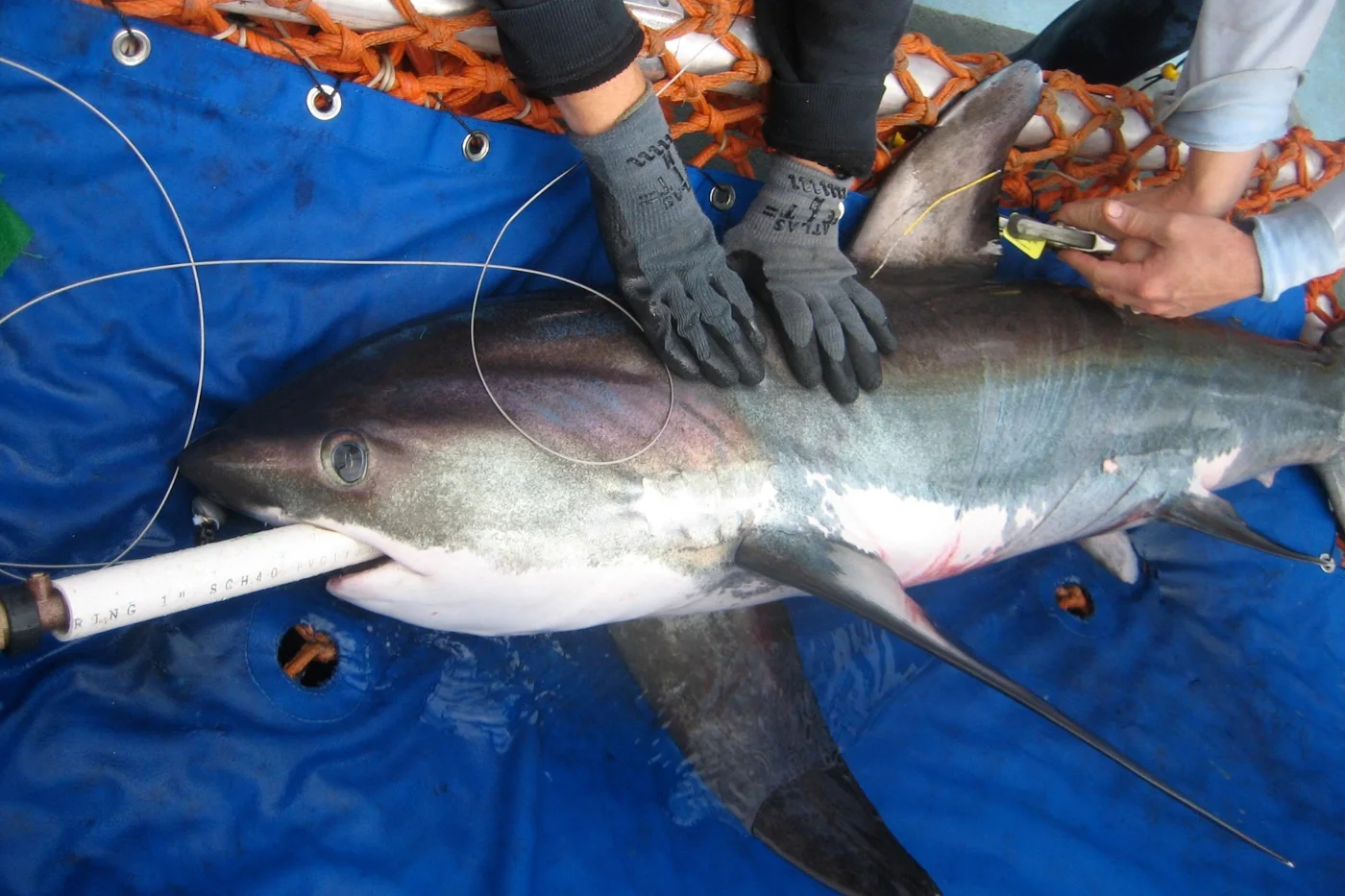

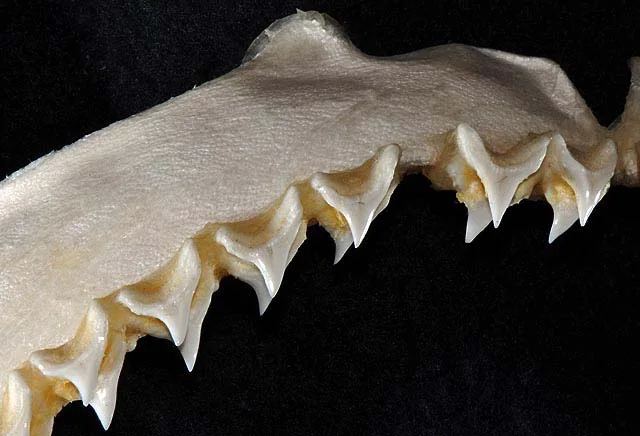
Wildlife education
This record supports wildlife education. Aquarium-care questions are not assigned to this profile.
The existing record is wildlife-only, not applicable, or explicitly outside the home-aquarium scope.
Alopias vulpinus is not recommended for home aquariums. This record explains wild biology and welfare concerns; it does not establish a suitable public-aquarium protocol. No minimum volume, footprint, temperature, salinity, pH, stocking rule or ration has been verified. Do not translate wild range or fishing photographs into husbandry limits.
A tail like no other
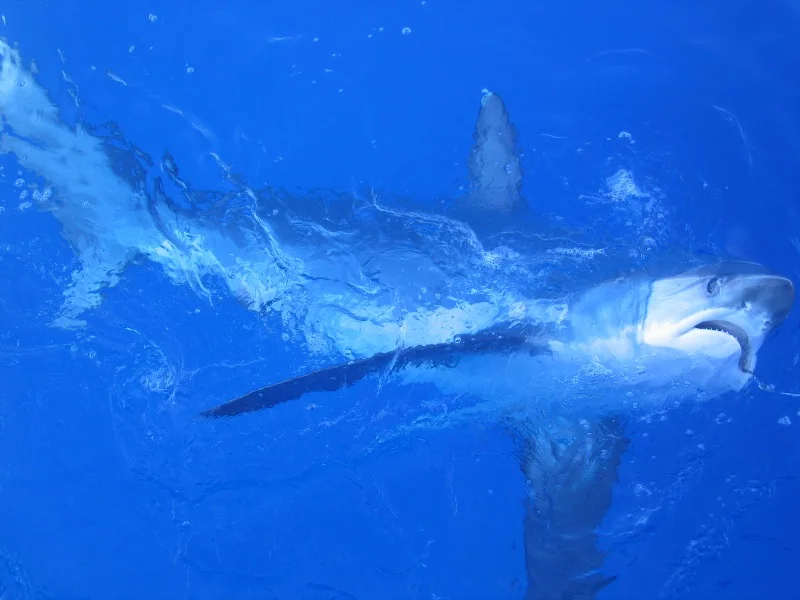
The common thresher belongs to Alopiidae, within the order Lamniformes. Its exceptionally long upper tail lobe is the principal field mark. Small smooth-edged teeth and a comparatively small mouth contrast with that dramatic tail. Common, bigeye and pelagic threshers are separate species; photographs must be matched to the correct name.
In Canadian waters
DFO describes Alopias vulpinus as a seasonal visitor to Atlantic Canada, with records extending to eastern Newfoundland, and as rare in British Columbia. These regional accounts describe occurrence, not a Canadian population estimate or a claim of year-round residency.
Habitat and movement
This is a mobile predator of coastal and offshore waters. NOAA describes seasonal eastern Pacific movements and nearshore habitat rich in prey. An animal occurring near a coastline remains part of a much larger marine system; a coastal sighting does not imply a sedentary lifestyle.
The tail is a feeding tool
Schooling fishes and squid form part of its wild diet. Aalbers and colleagues used underwater video off southern California to document common threshers initiating feeding events with their upper tail lobe. This species-specific evidence supports tail-assisted hunting without borrowing observations of pelagic threshers as though they were the same species.
A slow reproductive pace
The Atlantic NOAA account describes a long-lived shark with few offspring. Pacific NOAA describes internal development followed by live birth, typically two to four pups. Growth, maturity and reproductive timing vary by population; regional values should remain attached to their source.
Conservation depends on scale
CMS reports an IUCN global category of Vulnerable. NOAA’s Pacific page reports the U.S. Pacific stock as not overfished and not experiencing overfishing under the 2018 assessment. A regional fishery finding is not a global status assessment and is not a Canadian legal designation.
Aquarium suitability and welfare
Not recommended for home aquariums. Its active pelagic life and extraordinary tail make responsible housing a serious welfare question. The reviewed sources do not establish captive operating limits or a verified long-term institutional protocol. No tank size or water targets are invented here; wild biological measurements are not aquarium care prescriptions.
Observe, document and protect
DFO encourages documentation and reporting of shark encounters in British Columbia, with its stated dogfish exception. Observe without pursuing or touching the animal. Record a location, date and photograph when safe, and use DFO’s current shark research and reporting guidance. Fishing and tagging photographs in this gallery document particular interactions, not normal aquarium care.
Deeper care evidence review
Two search engines were queried for species-matched feeding, culture and rearing evidence. No applicable primary care protocol was accepted from the retrieved material in this bounded review. General natural-history accounts, related-species care and unexamined search candidates do not establish a validated ration or lifecycle protocol. Existing care evidence gaps remain open; this is not a claim that no further evidence exists. Remaining evidence gaps: Lifetime captive welfare; Minimum housing volume and footprint; Water operating limits; Captive nutrition and feeding frequency; Compatibility and transport. Full lifetime husbandry remains unverified.
Common Thresher Shark in Canada
DFO describes Alopias vulpinus as a seasonal visitor to Atlantic Canada, with records extending to eastern Newfoundland, and as rare in British Columbia. These regional accounts describe occurrence, not a Canadian population estimate or a claim of year-round residency.
- Canadian regions
- Atlantic Canada — seasonal visitor, British Columbia — rare
- Canadian status
- Global Vulnerable category; Canadian legal status is not inferred from that category.
A living record
Canadian regional evidence is scoped to DFO; global conservation and U.S. regional stock information are distinguished. Supplied common-thresher photographs are credited individually. Three pelagic-thresher photographs and one bigeye-thresher photograph were excluded from this species gallery. Aquarium limits remain unverified. Public content last reviewed October 2, 2026.
- DFO — thresher shark, Atlantic Canada ↗Government or intergovernmental source
- DFO — common thresher shark, Pacific Canada ↗Government or intergovernmental source
- NOAA Fisheries — Pacific common thresher shark ↗Government or intergovernmental source
- NOAA Fisheries — Atlantic common thresher shark ↗Government or intergovernmental source
- Aalbers, Bernal & Sepulveda (2010) — common thresher tail-assisted feeding ↗Primary research
- CMS Sharks — Alopias vulpinus, global conservation context ↗Government or intergovernmental source
- WoRMS — Alopias taxonomy ↗Taxonomic authority